A plain guide to Akkermansia muciniphila: where it lives, how common it is, why researchers study it, what live and pasteurized mean on a label, and how it appears in SodaTide's probiotic blend.

Editorial disclosure: sodatideguide.com is an independent guide and is not the manufacturer, distributor or seller of SodaTide. It contains affiliate links, and we may earn a commission if you purchase through them, at no extra cost to you. These statements have not been evaluated by the Food and Drug Administration. SodaTide is not intended to diagnose, treat, cure, or prevent any disease. Consult a healthcare professional before use.
Akkermansia muciniphila is a gut bacterium that lives in the layer of mucus lining the intestine and feeds on mucin, the main protein in that mucus. Its name says as much: muciniphila means "mucin-loving". It was isolated and described in 2004 by Muriel Derrien at Wageningen University in the Netherlands.
In the mucus layer of the intestine, where it uses mucin as its food source. A 2017 review calls it "a mucin-degrading member of the intestinal microbiota".
Front Microbiol 2017: AkkermansiaThe same review counts it among the most abundant single species in the human gut, at 0.5 to 5% of all the bacteria there.
Front Microbiol 2017: AkkermansiaResearchers describe it as a promising candidate for a "next-generation beneficial microbe": a gut bacterium studied for use as a supplement, beyond the classic probiotic groups.
Front Microbiol 2017: AkkermansiaThe 2017 review bases its case on "a variety of preclinical models", meaning laboratory and animal studies. Human research is at an early stage, beginning with small studies of tolerance.
The review reports that pasteurizing Akkermansia makes it more stable, and research has looked at both the live and the pasteurized bacterium. A supplement label should say which form it contains. The SodaTide label does not.
The NIH Office of Dietary Supplements lists seven core genera used in most probiotic products, such as Lactobacillus and Bifidobacterium. Akkermansia is not among them, which is why it is often called "next-generation".
NIH ODS: ProbioticsFindings about a bacterium in a study do not automatically apply to a product that contains it. The strain, the amount and the form all matter, and a label rarely shows all three.
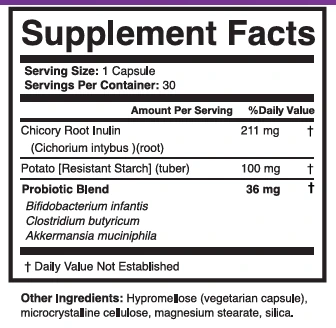
The SodaTide label lists Akkermansia muciniphila as the third strain in a 36 mg probiotic blend, after Bifidobacterium infantis and Clostridium butyricum. The capsule also holds 211 mg of chicory root inulin and 100 mg of potato resistant starch. The label gives no separate amount, no CFU count and no live-or-pasteurized statement for Akkermansia. It suggests keeping the bottle in the refrigerator. The full panel is on the SodaTide ingredients page.
A gut bacterium that lives in the intestinal mucus layer and feeds on mucin. It was first isolated in 2004, and a 2017 review puts it at 0.5 to 5% of the bacteria in the human gut.
It is studied as a candidate "next-generation beneficial microbe". It is not one of the seven core genera that the NIH Office of Dietary Supplements lists for most probiotic products.
In the layer of mucus that lines the intestine, where it uses mucin as food.
Pasteurized Akkermansia has been heat-treated, which a 2017 review says makes it more stable. Research has looked at both forms, and a label should say which one a product contains.
Yes. The label lists Akkermansia muciniphila in a 36 mg probiotic blend with Bifidobacterium infantis and Clostridium butyricum.
The label does not say. It gives one weight, 36 mg, for the whole three-strain blend and no CFU count.
It depends on the product. ODS notes that some probiotics require refrigeration and others do not. The SodaTide label says "Refrigerate for optimal quality".
SodaTide lists Akkermansia muciniphila with two other strains, chicory root inulin and potato resistant starch. Orders from the official page come with a 60-day money-back guarantee. Details are on the SodaTide ingredients page.
Open the SodaTide Order Page